Bank Reporting Pack: Call Report, CECL and Regulatory Capital Workpapers
Four Excel workpapers for SEC-registered bank holding companies: the Call Report and FR Y-9C tie-out to the 10-Q, the CECL allowance rollforward with the vintage table, deferred loan fees and costs, and regulatory capital ratios. Same one-cell roll-forward Setup and workpaper layout as the main templates. White-label, no macros.
Bank Reporting Pack
$39 if you bought the templates.
Checkout isn't open yet. Join the free list and we'll email you when it is.
Get notifiedCall Report and FR Y-9C to 10-Q Tie-out
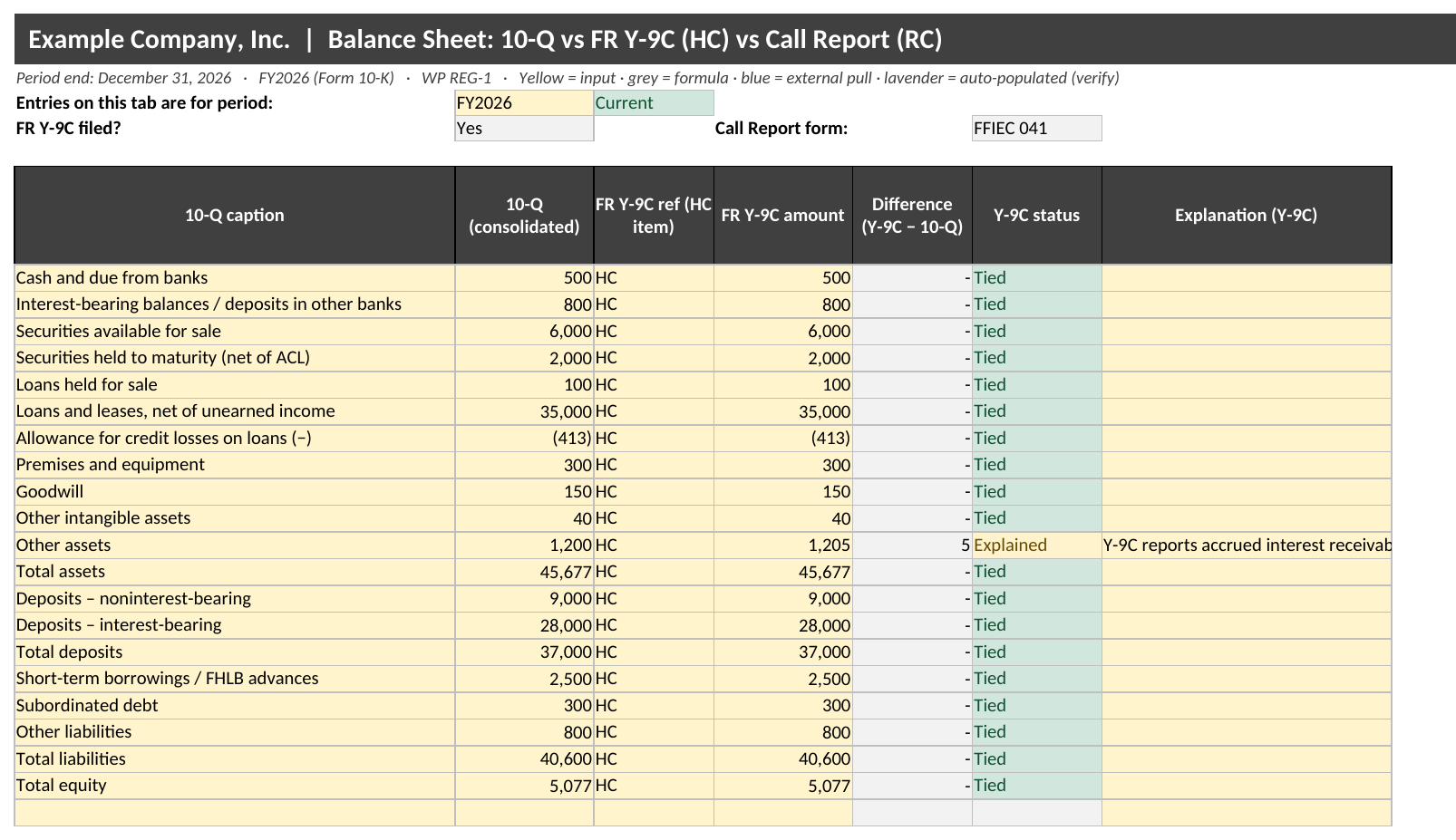
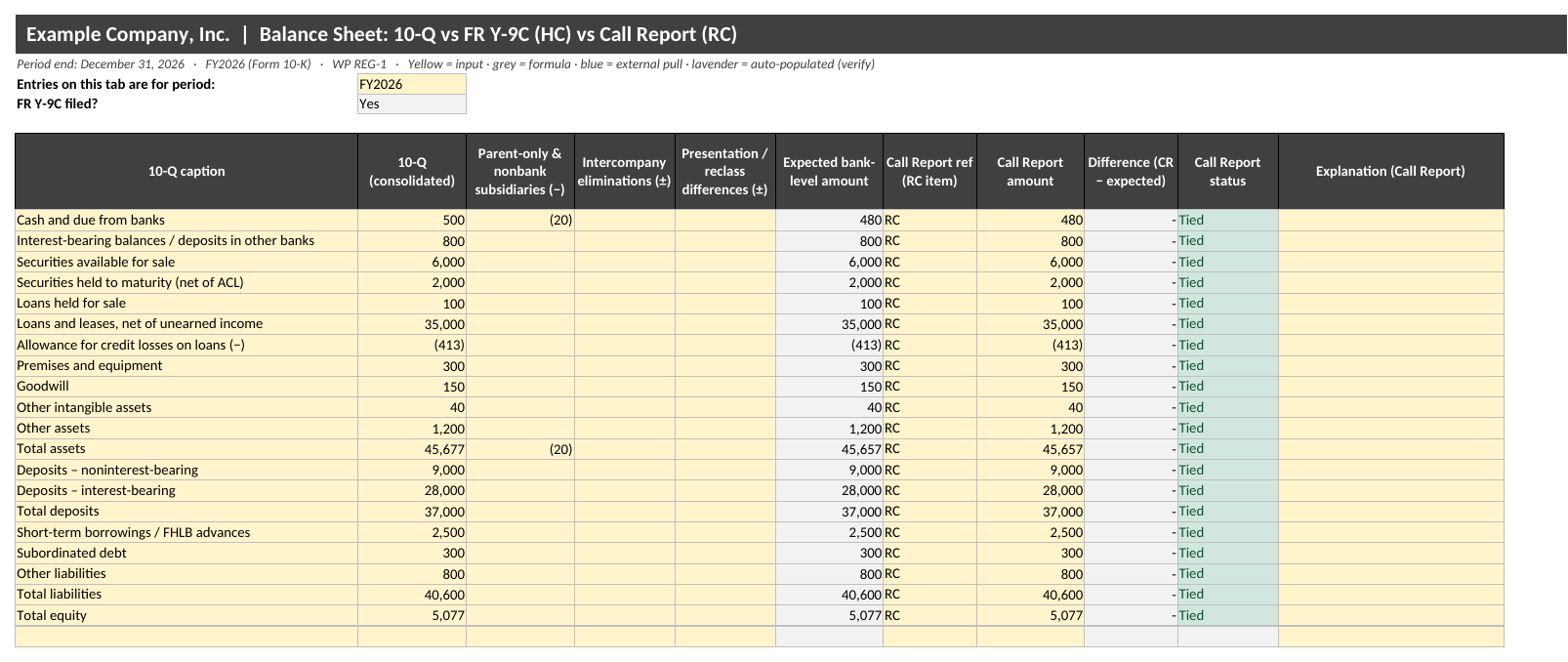
Ties the 10-Q or 10-K to the FR Y-9C (consolidated holding company) and to the bank's Call Report (FFIEC 031 or 041): parent-only and nonbank amounts, intercompany eliminations and presentation reclasses bridge the consolidated figure to the expected bank-level amount, line by line.
Tabs
- Setup – Call Report form, more than one foreign office, files FR Y-9C; derives the Call Report and FR Y-9C due dates from the period end
- Balance Sheet Tie, Income Statement Tie and Other Schedules (allowance, charge-offs, past due, nonaccrual, capital) – each line: 10-Q amount, Y-9C reference and amount, difference and status; then parent-only / nonbank, eliminations and reclasses to the expected bank amount vs the Call Report reference and amount
- Summary & Tie-out, Judgments, Completeness & Controls, Open Items, Sign-offs & Refs, Tickmarks, Holidays
Key checks
- Every line reads Tied, Explained, Investigate, Missing or N/A against both reports
- Income statement lines on a calendar year-to-date basis checked for non-calendar fiscal years
- Call Report due 30 days after quarter-end (35 with more than one foreign office); FR Y-9C 40 days, 45 after December 31
Balance Sheet Tie (10-Q to FR Y-9C)
Balance Sheet Tie (bank level to Call Report)
CECL Allowance Rollforward
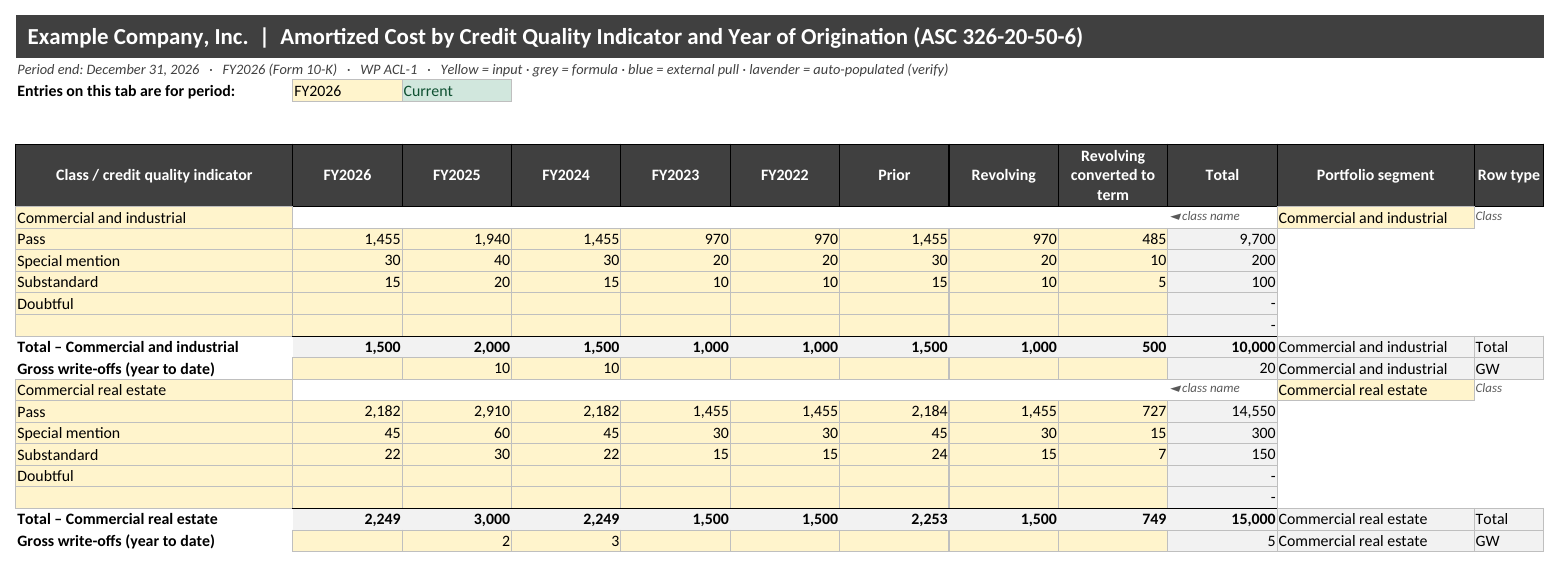
Supports the allowance for credit losses note and the Item 1405 credit-ratio tables: segment rollforward, the quantitative / qualitative / individually evaluated build, qualitative-factor support, and the vintage table of amortized cost by credit quality indicator and year of origination with gross write-offs by vintage.
Tabs
- ACL Rollforward – by portfolio segment: beginning, PCD, provision, charge-offs, recoveries, other, ending; loans, ACL %, net charge-offs and NCO % of average loans; unfunded commitments reserve
- ACL Build – quantitative, qualitative and individually evaluated components by segment
- Q-Factors – the nine qualitative factors from the 2020 interagency policy statement, with direction, basis-point adjustment, data and rationale
- Vintage – up to six classes of amortized cost by credit quality indicator and origination year, revolving and revolving-converted-to-term, with gross write-offs by vintage (ASC 326-20-50-6)
- Item 1405 Ratios – allowance to loans, nonaccrual to loans, allowance to nonaccrual, NCO to average loans by category
- Summary & Tie-out and the standard framework tabs
Key checks
- Rollforward ending ties to the build and to the balance sheet; vintage totals tie to segment loans
- Gross write-offs by vintage tie to rollforward charge-offs for the year to date
- Qualitative adjustments need a rationale and data source; the Q-factor total ties to the build
ACL Rollforward

Vintage
Deferred Loan Fees and Costs (ASC 310-20)
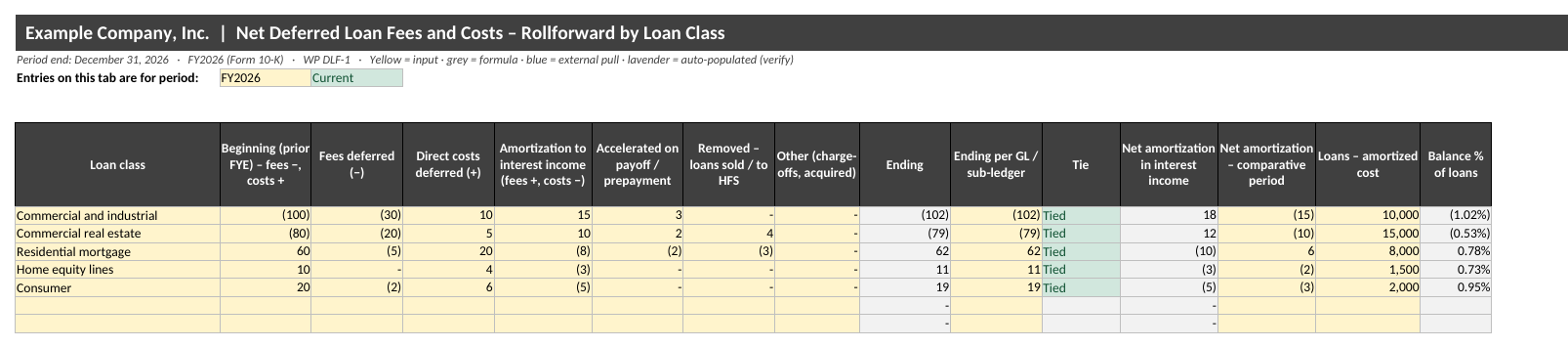
Rolls forward net deferred loan origination fees and costs by loan class – deferrals, amortization, accelerated recognition on payoffs and sales – and tests amortization for reasonableness against a straight-line estimate.
Tabs
- Rollforward – by loan class: beginning, fees deferred, costs deferred, amortization to interest income, payoffs / sales / charge-offs, ending; method (interest method or straight-line for revolving lines) and remaining life
- Reasonableness – an analytical straight-line estimate vs recorded amortization by class, with a tolerance
- Summary & Tie-out and the standard framework tabs
Key checks
- Ending net deferred fees / costs ties to the loan note and the GL
- Amortization outside the tolerance reads Explain until documented
- Interest method expected except for revolving lines and other permitted cases (ASC 310-20-35-18, 35-21)
Rollforward
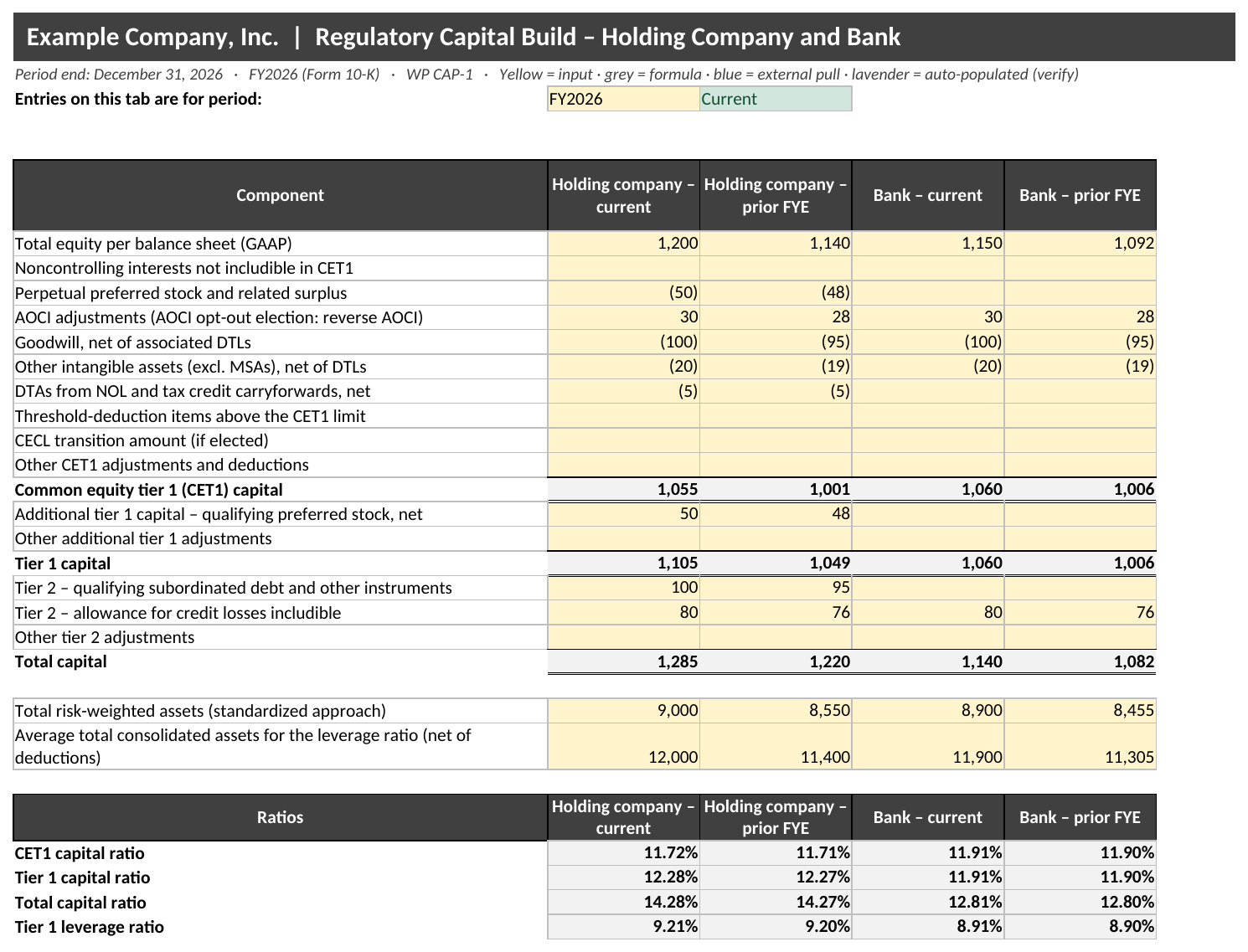
Regulatory Capital Ratios
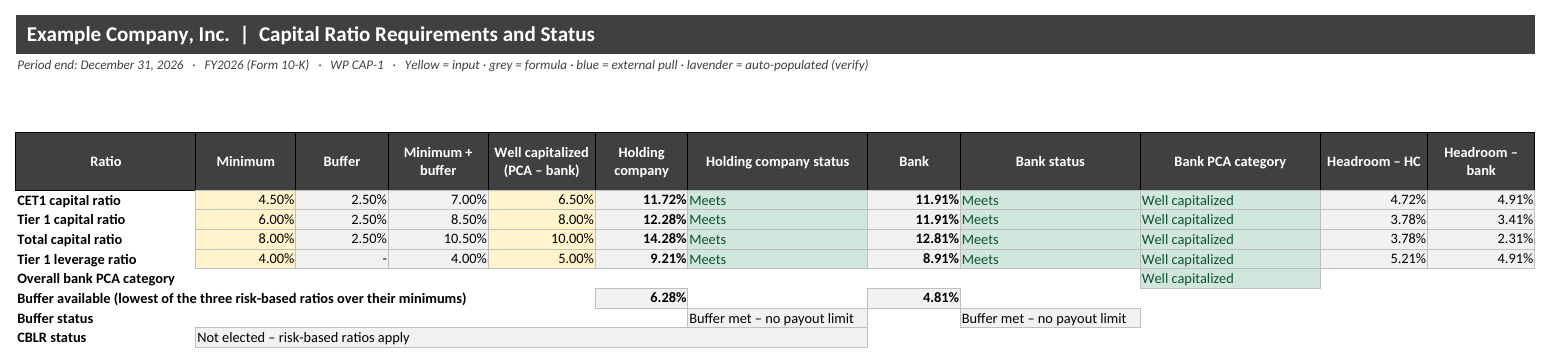
Builds CET1, tier 1 and total capital for the holding company and the bank, with risk-weighted assets and average assets, and compares each ratio with the minimums, the buffer and PCA well-capitalized thresholds – tied to FR Y-9C Schedule HC-R, Call Report Schedule RC-R and the 10-Q.
Tabs
- Capital Calculation – from GAAP equity through CET1 adjustments, additional tier 1 and tier 2 (allowance includible capped at 1.25% of RWA), for holding company and bank, current and prior fiscal year-end; ratios
- Ratio Requirements – minimums (4.5% / 6% / 8% / 4%), buffer (2.5% or your stress capital buffer), PCA well-capitalized (6.5% / 8% / 10% / 5%), headroom and status; community bank leverage ratio option (9%)
- Ties – amounts and ratios to HC-R, RC-R and the filing draft
Key checks
- Each ratio shows headroom over the minimum plus buffer and the PCA category
- Headroom under the Setup threshold reads tight; ACL in tier 2 over 1.25% of RWA is flagged
- Ratios tie to the reports and the filing within a ratio tolerance
Capital Calculation
Ratio Requirements
Primary sources
- FFIEC Call Report forms and instructions (031 / 041)
- FDIC – Call Reports
- Federal Reserve – FR Y-9C
- Regulation S-K Subpart 1400 (bank holding company disclosures)
- Regulation Q (12 CFR 217)
- Interagency Policy Statement on Allowances for Credit Losses (2020)
- FASB Accounting Standards Codification (ASC 326, ASC 310-20)
Previews are rendered from the actual workbooks with illustrative sample data ("Example Company, Inc.", period end December 31, 2026). The pack is a separate add-on and is not included in the $69 templates or the $89 bundle. Not legal, accounting or regulatory advice.